Thursday, March 3, 2016

Inspiration from Sappington...

Today, I participated in district walk-throughs, visiting Sappington Elementary and observing a wide array of instructional best practices.  Often, we think that elementary learning looks so different than learning at the middle level, but should it?

In the classroom....
Math Anchor Charts:  As students work in math stations, these charts provide reference for increased student independence.

Learning Objectives as "I can" statements

Integration of Science and Writing:  In this 2nd grade writing unit, students are writing about force and motion, providing specificity and clarification of scientific terms in their writing and developing an index of main ideas.

Math Review:  As students worked independently to review their concepts, the teacher conferenced with small groups of students.
Math Review:  A combination of high and low tech
Math Review:  Conferencing with small groups of students to identify and remediate misconceptions.
Anchor charts to work on closing paragraphs in writing.
Student Writing and Publication:  Go to Seesaw to learn more about the student's book.
In the Library....

Dash and Dots:  During library time, students program their robots to catapult objects, reading a Level 4 DOK.

Students have suggestions for using technology for higher levels of DOK.

An Idea Shelf:  Whatever the theme, students determine how to represent it and expand on the idea through their own creativity.
 In the Gymnasium....

Core Workouts:  Students scoot along the rope  as if acrobats in training.

Who thought you couldn't paddle board in a land-locked gym?

What used to be a recess staple...
 
Rock Climbing

Ropes and Swings

Building a shelter

Virtual Kayaking

Todd!

Todd!
 The energy of this PE class was amazing as students had outdoor adventure inside!  The criteria was that students access each station once and check their heart rates periodically.  This fun and engaging lesson connected kids to fitness in the real world.


Monday, February 22, 2016

What is Curiosity?

Last week, I was in a Project Lead the Way (PLTW) meeting talking about science, technology, engineering, and math (STEM) with both educators and parents in STEM fields.  One of the key points of the discussion was how much we control the learning of students rather than giving them the opportunity to build knowledge based on their curiosity.  It was then reinforced when my monthly "Education Update" arrived in my mailbox on Friday.  And, one of the articles, "The Wonder Years," highlighted how to nurture students' natural curiosity by making time for wondering.  The article highlights that "Curiosity released dopamine, a neurotransmitter that helps improve noticing and affects attention and remembering.  When your curiosity is piqued, you're going to remember things more deeply."  Doesn't this make sense?

So let's look at what made us curious today at TMS...


What do all those charts on the TV news mean?  Before teaching them the content, have them engage with the map, questioning what the signs and symbols mean.

How do instruments make sound?  Students created instruments with random materials.

The vibrations of the tin were amazing.

Carrots for clarinets, Styrofoam for xylophones and so much more...

Students played the stock market before learning about it from an expert who could answer all their questions.
I challenge you to use student curiosity to build content knowledge in your classroom.  And, here's how:  don't give them the information...in any form, readings, video, lecture, etc.  Instead, let them explore it and figure it out.  Give them a real issue to grapple with, build their frustration, develop their understanding, and then tie it all together in a neat little bow with your added knowledge.

Thursday, February 18, 2016

Mountain Woman Hake and Sheriff Frank Rule the West: An Interdisciplinary Study

Planning authentic and relevant interdisciplinary learning takes a lot of coordination and flexibility, but the time invested is well worth it.  In 6th grade, students benefit from the integration of social studies and math, with some embedded ELA.  As students study Westward Expansion, they earn money for their future journey along the Oregon Trail, saving it to purchase necessary supplies to ensure safe passage across the wild frontier.  However, not all purchases are easily made; converting units of measurement is essential when trying to determine cost ratios.

If only you could hear the diction of this wild west woman - it's truly authentic. 

If I want 500 lbs of flour, what's my cost?

Designing the supply list requires students to play a historical game of chess - How many lbs of found will be needed in the coming months?  What strategy is essential for balancing needs with feasibility of transport?

So many options, so little money and space...

To get into character, students get a frontier name and determine family status.

Students read to build background knowledge.

As students journal in the coming lessons, they document their unique journey.  By the roll of the dice, they may cross a too-deep river to find they've lost valuable supplies, or have the good luck to find a shallow spot, ensuring they continue the journey without loss.

Student-Led Isn't Just for Conferences

Giving students ownership of their learning and learning needs builds skills for future success as students lead their own IEPs.


A 7th grader led his IEP with a self-designed PowerPoint of his schedule, strengths, weaknesses, and accommodations.
In February I ask you to take a risk in your instruction, and as you reflect on your progress on that, consider how often kids take risks each day.  A student presenting their IEP to a group of adults, including their parents, teachers, counselor, and principal is definitely a risk!

Monday, February 8, 2016

A Valentine's Lesson on Speed Dating

In the adult world, we all know what speed dating is:  a large setting of single adults who have timed conversations with a person before moving on to the next person in line.  Doesn't sound appropriate for a middle school, right?  Wrong!  What if instead of people, students speed date with...wait for it....books!

In this library lesson, students have a selection of books on the table and a book list to rank what they've reviewed.  If they rated anything a 5, they may check out the book at the conclusion of the lesson.  What a great way to get kids excited about new book options.


Wednesday, February 3, 2016

The Challenge is Yours

"Take a Risk" February can take many forms.  It can result in a new technology tool, a teaching strategy that enhances current curriculum, classroom procedural changes....the list is endless.  Today, I witnessed a team-building activity with potential to build a classroom community, reset the classroom climate, and connect to curricular skills.

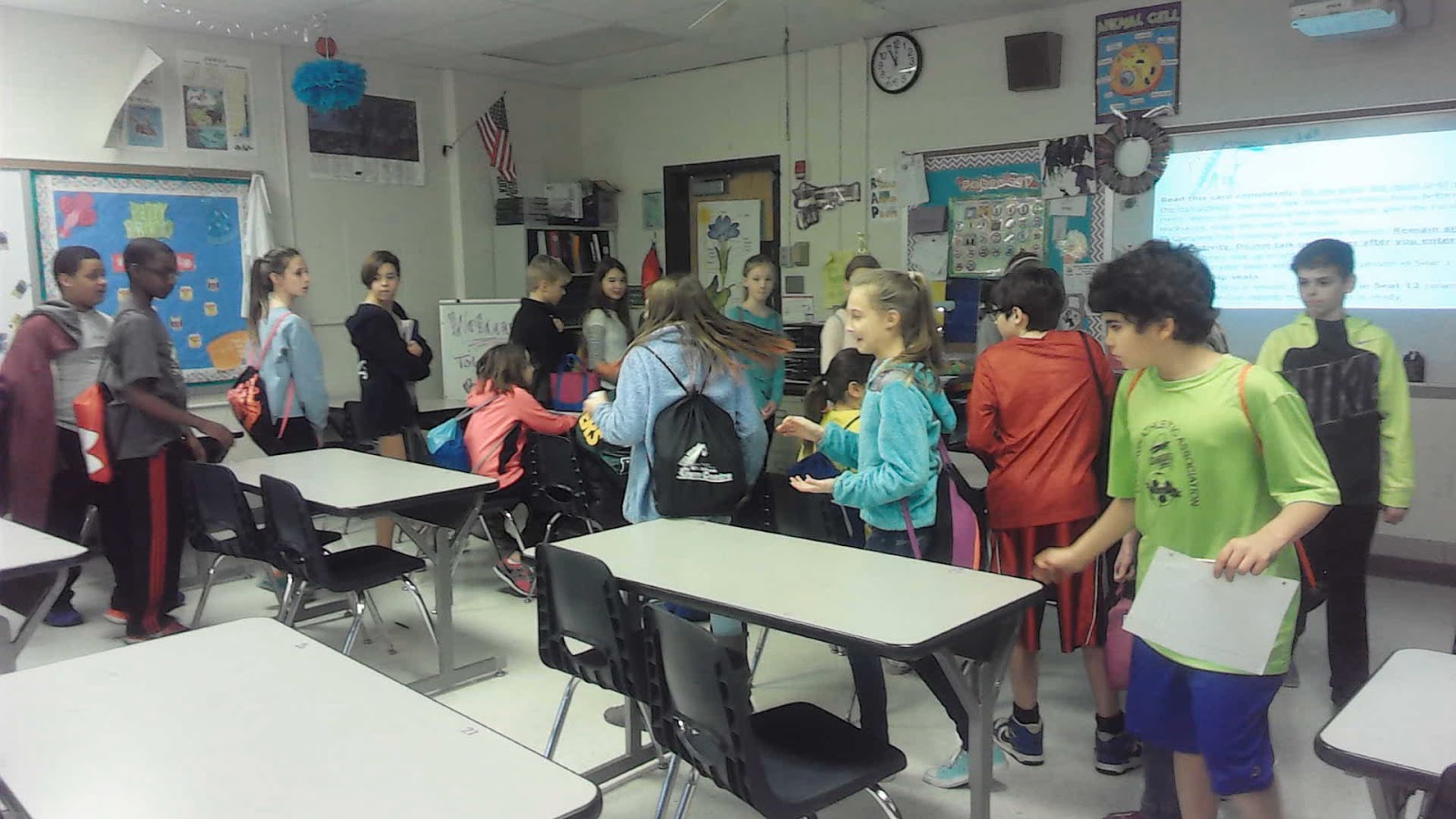
Before entering the room, students were given directions to line up silently by height and and find their numerically ordered seats by that line-up.

Attempt #1:  Getting to their seats after lining up.

Trying to find the randomized numbers...still without talking.

Almost there....I think.

Regrouping once their original plan failed.

A new strategy:  identifying a leader to help match students to the correct seats.

Using their skills - students annotate the directions to ensure accuracy.
 In this example, student's used problem-solving skills, adding strategies to correct their errors in the first trial.  The parallels to a science classroom are endless as we make comparisons to scientific inquiry.

Monday, February 1, 2016

Making Direct Instruction Engaging - A Rare Occurrence

There are a few components of our new teacher observation tool where it's difficult to reach proficiency in the student engagement section: Presentations, Question and Answer, and Direct Instruction to name a few.

Student Presentations are greatly engaging for the student who has designed the presentation, but for those students on the receiving end, it's a challenge to ensure that their learning is progressing through active engagement.  Since we can't expect middle school students to deliver a highly engaging teachable moment, that's up to us to design a system where they are responsible for the information provided from their peer.

For Question/Answer, to make it engaging there has to be more than compliance.  Whole class Q and A is most frequently in the emerging category.  If you add required whole class involvement in Q and A (such as fist to five or other similar formative feedback), it'll move to developing, but to be proficient, students have to be held accountable at a higher level.  Most likely, this includes partner sharing or justification of their response.

Today, I saw my first example of student engagement proficiency using the Direct Instruction strategy.  Typically, direct instruction is emerging or if there is compliance in note-taking, you may see developing in this area.  But, to progress learning, we need more than just compliance and everyone on task - we need learning demonstrated.  Today, I saw it!

As the teacher provided the direct instruction about a new concept, students listening and reformulated the information into their own project.  This wasn't note-taking -- it was "note-applying."

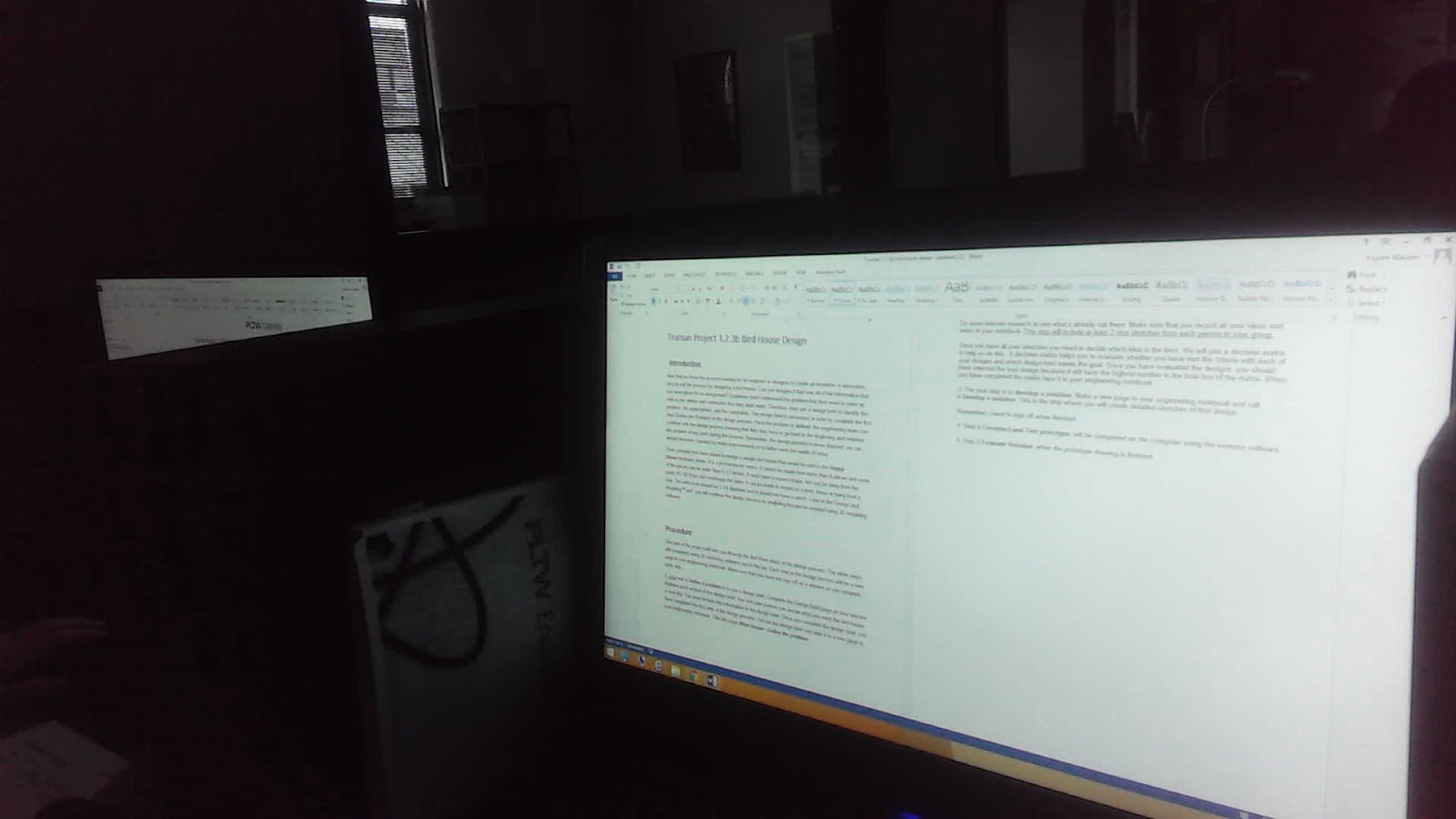
The design process was presented as students outlined their own project, applying the components of their new learning.

The complexity of this task was increased as students cross-referenced their project directions with the design process.