Showing posts with label RAP. Show all posts

Thursday, April 21, 2016

Reading, Rapping, and Mapping

You might think that I'm referring to MAP testing, but nope!  I'm talking about geography skills and all the other great learning that is happening in 6th grade this week.  Check it out!


Students present their learning to the class in science, designing a Kahoot to engage their peers.
How low can you go?  Students meet in a small group to ensure mastery of the lowest common denominator. 
Students are differentiated into math groups to work at their level.  In this case, students practice the concept with manipulatives.
As groups work together, the teacher leads one to ensure mastery of the concept.
As students read, they continue to annotate, making note of important sections of the book.
As students give presentations in science, students are held accountable for learning the material presented.
Those science presentations again....
What a great idea!  As students write, they are given a template to organize their thinking. This template easily wipes clean for the next student to use.
Students collaborate to summarize main ideas and other learning objectives in visual form.
Students lead learning in a small group.
The roll of the dice determines what students learn - this is a fun way to "gamify" learning.
Stations:  Students plan a game to demonstrate their knowledge of the US.
Stations:  Students are RAPping.
Stations:  More mapping.

Wednesday, November 13, 2013

Switch Up!

Getting kids to think critically requires that we give them diverse thinking experiences. In one teacher's RAP lesson, she switched it up for kids by making them read the answer in order to determine the question.  Literally, the kids have to understand RAP strategy backwards and forwards.  The below picture shows how students had to comprehend the answer before deciding, "What's the question?"

As a follow-up, students can evaluate the quality of the answer. 

Monday, November 11, 2013

We do Literacy "Write" with Dialogue and RAP

Literacy across the content areas is one of the keys to future success for our students and our schools.  Check out these great examples of literacy, especially dialogue, in various content areas...

Literacy includes debate, specifically dialogue that requires kids to practice speaking and listening.  In this social studies class, students are writing and debating the pros and cons to a caste system.
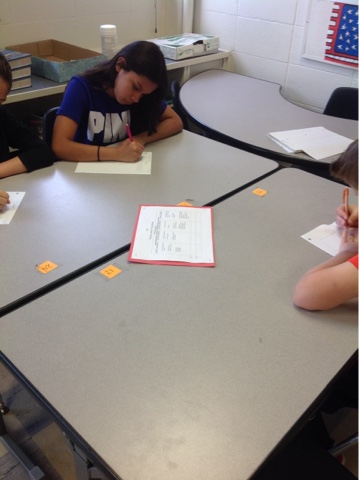
RAPing it Write:  these students are predicting which parts of the RAP continuum are scored as 1, 2, 3, and 4.  The beauty of this exercise is that students are delving deeply into their writing expectations.
Using the RAP continuum, this teacher has students reflect on their individual progress.

Literacy in Geometry:  These students work collaboratively, communicating with one another about how to solve problems.  The dialogue here is rich and results in greater mathematical understanding.

These Pilots are incorporating great dialogue strategies as well.  In their digital citizenship lesson, they broke students into groups to require increased participation and engagement through discussion.

Sunday, October 27, 2013

6th Grade - the Foundation of Middle School Learning

Instruction in 6th grade is ever-important, and like all of us, 6th grade teachers continue to try new things to improve the rigor and relevance of learning at TMS.  Check out these examples; they definitely point to the vertical and horizontal alignment at TMS...

Color-marking in English - this sets students up for success as they continue to color mark in 7th and 8th grade.  Great vertical alignment!

Collaborative teaching with students - A student who was absent the day before worked with a partner who caught her up on learning.  Both students benefit:  one solidifies their knowledge while teaching the other and the other gets a summary of missed work.

Science notebooking - NO!  This is math notebooking!

Students tracking their own notes helps them develop responsibility and gives them resources for future reference.

Learning is fun (and tactile!) - Here's an example of geometric principles in action.

Best Practices - Essential questions, RAP reminders and Scoring Rubrics.

Wednesday, October 16, 2013

Balance Beam

I often talk about the balance we must find in education, the balance between reading and writing, between student accountability and student support, between basic skills and critical thinking skills, between right brain and left brain.  It often feels like we are walking a tight rope, trying to find ways to reach the perfect balance, to keep it all from falling apart.  And we are, BUT we are also great acrobats!!!!

Check out how we keep our balance...

We have a little fun with our geometry puns!  If you can't read them here, stop into Megan Scott's room for a little funny math.

We balance our expectations and let students know what they are so they have a purpose for learning too!

We connect our basic math to relevant information.  After all, don't all students want to understand fractions so they can divide that Halloween candy evenly?

We hold kids accountable for doing the essential work of class.  These students have been pulled out to complete their work - sometimes, getting it done is not good enough.  We require kids to get it done correctly!

When teaching RAP, we put things in kid-friendly language, but we still hold them accountable for demonstrating skills. 

We balance the skills of writing with the higher level skills of evaluation when kids score different RAP examples.  In this lesson, students scored writing by using the four corners of the room.  One corner was a 1, one was a 2, etc. where students had great discussions about high quality writing.
We have kids practice their listening and notetaking skills while documenting book talks...after all, there may be some good books that they want to read in the future.

We have fun on 'er day with a student as the teachER.

Thursday, September 26, 2013

It's after Labor Day, but Vogue says it's okay to wear white pants

Here I go, again...talking about taking instructional risks (see my previous entry about risk taking and wearing white if you're confused by the title).  But, in this case the risk is balanced with a process called Lesson Study.

The math department is getting ready to embark in "Lesson Study," and for those of you who haven't heard of it, here it is in it's purest form:

Step One:  Determine the teaching strategy you want to try (i.e., your risk).
Step Two:  Plan the lesson using the strategy within your PLC and with any necessary support.
Step Three:  Teach the lesson in one class while the other PLC partner observes, makes notes, etc.
Step Four:  Reflect upon the strategy and make changes for future implementation.
Step Five:  Use "Lesson Study" strategy in future classes and adapt for future lessons.

As a systematic strategy, it works to pull teachers from a class to observe one another and have a thorough reflection process, but there are other ways you can "take the risk" without going to this level of study.

Here, a PLC is teaching the same outcome.  In one classroom, students are doing a Webquest to research the time while in the other, students are writing letters from the perspective of those within the time period.  Both outcomes should be the same, yet the teachers have very different strategies to teach the content.  During their PLC discussions after the common assessment, they can determine which strategy was most impactful.  This is a form of lesson study.
Webquest

Using resources and notes to write letter

Organizing their writing

Prior to our RAP PD session on Sept. 18th, a PLC did a "lesson study" on the RAP continuum.  Working with one class of students, they practiced scoring and building understanding of a strong RAP strategy.  This practice before implementation with staff, allowed us to see any flaws/challenges with the strategy.
The Continuum