Showing posts with label Interventions. Show all posts

Thursday, April 21, 2016

Reading, Rapping, and Mapping

You might think that I'm referring to MAP testing, but nope!  I'm talking about geography skills and all the other great learning that is happening in 6th grade this week.  Check it out!


Students present their learning to the class in science, designing a Kahoot to engage their peers.
How low can you go?  Students meet in a small group to ensure mastery of the lowest common denominator. 
Students are differentiated into math groups to work at their level.  In this case, students practice the concept with manipulatives.
As groups work together, the teacher leads one to ensure mastery of the concept.
As students read, they continue to annotate, making note of important sections of the book.
As students give presentations in science, students are held accountable for learning the material presented.
Those science presentations again....
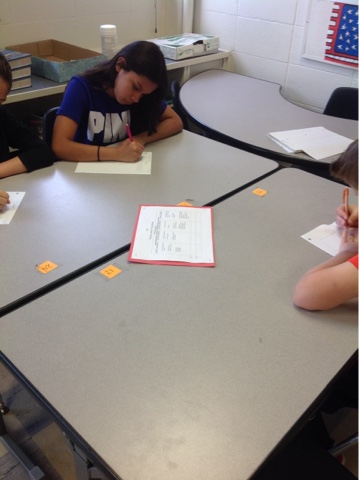
What a great idea!  As students write, they are given a template to organize their thinking. This template easily wipes clean for the next student to use.
Students collaborate to summarize main ideas and other learning objectives in visual form.
Students lead learning in a small group.
The roll of the dice determines what students learn - this is a fun way to "gamify" learning.
Stations:  Students plan a game to demonstrate their knowledge of the US.
Stations:  Students are RAPping.
Stations:  More mapping.

Thursday, October 1, 2015

Collaborative Teaching

Collaborative teaching can take many forms:  CT classes with special and general education, interdisciplinary lessons, PLC lessons, and library collaboration.  See these great examples of collaboration in effect.

Working with students on their Google Slides.
Teaching Spanish in this "Genius Hour."
CT with 2 teachers assisting students.
CT with Co-Teaching -- both teachers take ownership for primary classroom instruction.

Thursday, April 16, 2015

April Showers...

...Bring May Flowers!

Sometimes, it takes a little extra work to get kids to see the fruits of our labors.  Spring is just a metaphor for learning.  Students work hard all year long (as well as through May) to master new skills.  This hard work takes many different forms...
 

Collaboration is hard work!  It often seems like for kids, but it takes social and academic prowess to do it well.  In the above pictures, students collaborated to determine when to use various graphs.  They collected the data, and in some cases, multiple types of data are required.


Learning the tools is hard work!  To get comfortable with testing, students had to practice the online tools.  Teachers designed specific tasks to ensure students knew which tools were available and how to use them.


Teaching peers is hard work!  Students need to understand the skills well enough to explain them to others.  As a bonus, those who do, get to play a little b-ball.


Getting kids to understand practice makes perfect is hard work!  Students demonstrate mastery of skills by rotating around the classroom, working the various problems.


Getting students to see school as life is hard work!  These students learn the difficulty of budgets and spreadsheets.  Maybe they can work on the Sparks family finances next...


Spending extra time in the classes that are most difficult for you is hard work!  Students in interventions work hard to build vocabulary and math skills.

Monday, January 26, 2015

Interventions at Work!

It's a long list of supports we provide to students:
Power Lunch
Homework Recovery
Additional School Instruction (ASI)
Reading Strategies
Writing Lab
Math Lab
Academic Lab
Learning Lab

This isn't just a list, though; it's the difference between good and great!  Meeting kids at their level and providing interventions pushes them to reach their potential, so check out some of these great interventions in practice.

Conferencing with students on their persuasive writing - giving detailed feedback for ongoing growth

Getting kids to acknowledge how they think about reading, before, during and after reading = Metacognition

One on one support that builds fluency and comprehension

Online supports that match skills with lessons on ALEKS

Building motivation for improvement over time