Monday, April 25, 2016

Common Nouns within our School

As we design instruction, the verbs are essential!  They tell us what students will do with their learning, how they'll demonstrate mastery.  But, the nouns of education are also important - don't ignore the great things at TMS!

Post-Assessment:  Students set goals in PE early in the based on their fitness scores; now it's time to see if they met their goal - for most, it's not a surprise as they've monitored their progress throughout the year.

Collaboration:  Students give their muscle to help a friend build a birdhouse in tech ed.

Conceptualization:  Students compare the modern day map of Asia by restructuring it into the ancient world view of the region.

Presentation:  Students conducted an experiment of their own and presented their findings the class.

Research:  Students had to build background knowledge before designing the experiment.

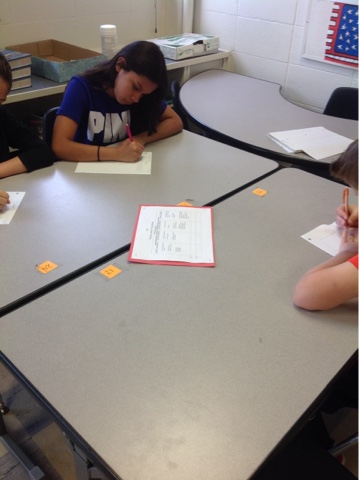
Procedure:  Students detailed the steps of their experiment.

Data:  Students need to review data in order to draw conclusions.
So whether your instructional nouns are post-assessment, collaboration, conceptualization, presentation, research, procedure, data, or something else, keep it up because there's great learning at TMS!

Friday, April 22, 2016

Retention : Understanding as Engagement : Active Learning

If you want learning targets to be retained over time, students must understand the concept, and the best way to do that is through engaging learning opportunities.  By planning active learning, you reach students, helping them make connections to concepts that can transcend one lesson on one day of their middle school life.

Getting ready for Tug of War
But, it's not so simple; you think one team has the clear advantage....

But, there's are traitors in their midst.

Students figure out their traitors and why a clearly favored team doesn't win as they make connections to the Vietnam War.

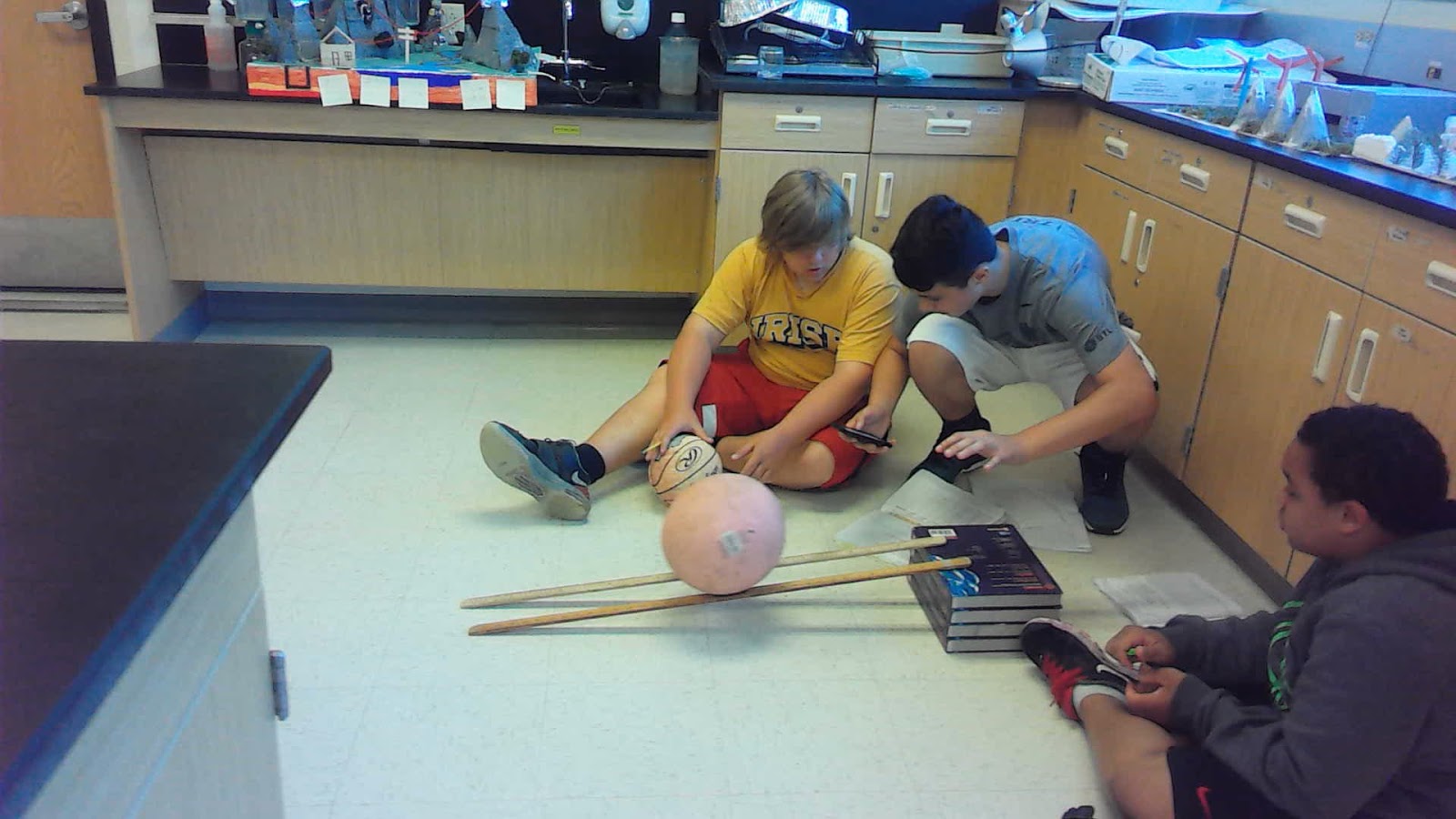
Weigh the ball.
Conduct the experiment.
Chart the data!
Collaborate to figure out the impact of mass on speed of an object.


Thursday, April 21, 2016

Reading, Rapping, and Mapping

You might think that I'm referring to MAP testing, but nope!  I'm talking about geography skills and all the other great learning that is happening in 6th grade this week.  Check it out!


Students present their learning to the class in science, designing a Kahoot to engage their peers.
How low can you go?  Students meet in a small group to ensure mastery of the lowest common denominator. 
Students are differentiated into math groups to work at their level.  In this case, students practice the concept with manipulatives.
As groups work together, the teacher leads one to ensure mastery of the concept.
As students read, they continue to annotate, making note of important sections of the book.
As students give presentations in science, students are held accountable for learning the material presented.
Those science presentations again....
What a great idea!  As students write, they are given a template to organize their thinking. This template easily wipes clean for the next student to use.
Students collaborate to summarize main ideas and other learning objectives in visual form.
Students lead learning in a small group.
The roll of the dice determines what students learn - this is a fun way to "gamify" learning.
Stations:  Students plan a game to demonstrate their knowledge of the US.
Stations:  Students are RAPping.
Stations:  More mapping.

Thursday, April 14, 2016

A Sneak Peak into Modern Language Learning

I got the chance to pop into 3 classrooms today, and wow, each was engaging and relevant, increasing both student understanding and skill.

A Roll of the Dice:  Students review a Spanish grammar concept, writing as many of the newly acquired skill as they can before the next person in the group rolls a "5."

The energy and focus was a buzz into the classroom.

In German, students write about themselves...in the language.

The writing is both rigorous and relevant as students make connections between their art and language skills.

Conferencing is not just for ELA!

Students roll dice to construct a sentence in French.

The race is on to be the first to write an accurate sentence.

Her group is proud of how she applies her French grammar skills.

Thursday, March 10, 2016

I'm the Best Thief!

Last week I shared pictures from my walkthroughs at Sappington Elementary, and this week I get to share ideas from both Sperreng and Concord from our district PDC walkthroughs.

Long ago, I realized that I am not the most creative of people, but like any learner, I've accommodated this weakness...I've become a thief.  Very little of what I do was an original idea; instead, I see things that inspire me and morph them into a system or structure that works for me.  As I share the ideas believe, I encourage you to become a thief...think about how you can make any of these ideas work for you.

Let your students know you.  This simple visual lets kids see what they have in common with you and supports building relationships.

Conference with kids.  Pulling kids into another section of the room to meet with them gives them a sense of purpose and direction, as well as a chance to move.

Clever Visuals:  Whether it's the "math stairs" floating around on Facebook or inspirational quotes as shown here, consider how we can use our space to reinforce learning.

Visual Learning Supports:  This chart provides both graphic representations and detail to help all types of learners.

4th Grade ELA Learning - they really have learned this before!

Clever "Whiteboards" - these placements serve as dry erase boards for students in small group learning.

Common book themes - as students read throughout the year, they identify which of the common themes their book showcases.

Announcements on a scrolling screen - as students do their morning work, the announcement scroll on the whiteboard.  This may be a good fit for Flyertimes next year.

The learning in this classroom is spiraled with the teachings of our middle school ELA classes.


Flyervision - this short video announcements are led entirely by students.

A clever roll of the dice to get kids writing.

Visual math - the associated vocabulary is on the symbol

Book Club norms

An elementary schedule - this is how they really spend their time.

Encouraging reading with visual supports.

Encouraging reading school-wide.
Helping students pick books and holding them accountable for being a "real reader."