Friday, May 23, 2014

We're always thinkin'

It may be May, but we are still thinking, and learning, and thinking, and learning...

Designing and Creating Structures

Beating his time solving the Rubik's Cube

Charting Data

Building Rockets
Getting ready to launch and the launch below

A successful launch
Taking a Final (Yes, I Said Final)

Geometric Wallpaper

Finding Examples of Simple Machines Around the Building

Reading background information

Discussing historical events and bias


Thursday, May 22, 2014

Not Your Momma's Interview

Interviews are changing.  Gone are the days where we meet you for 30 minutes, ask you some questions, and then bam, you're selected.  This year, we've seen most of our candidates teach.  Whether it's a Fellow we've hired (because, let's face it, isn't the Fellows program a yearlong interview? - assuming there's an opening, of course).

In the pictures below, a prospective PE candidate taught an integrated health/fitness lesson to our 6th grades.  Spoiler Alert - we hired her!


Students rotated through stations for their warm-up.  Stations were highlighted by color-coded cones and technology that timed and transitioned students between activities.

A quick mini-lesson on "My Plate" to lead into the main event of the lesson.

Students worked in groups to "create" their plate.  Each item taken from the center had a physical activity to complete.
After gathering all their foods, students designed the healthiest option based on "My Plate's" portions.
A little yoga to mentally and physically end the class.


Wednesday, May 7, 2014

No Trash Talk

When science teachers ask you to save your "garbage," don't you wonder what they're going to do?  After all, why do they need all of those 2-liter bottles, jars, paper and other random products?

To create, of course...

See the pictures below as the race was on in one science classroom:  with the time and materials  given (paper and 1 meter of tape only), students were to create the tallest tower they could.  And, there was no trash talk allowed!

Prepping the classroom is messy work

The competition begins

Survival of the fittest
Building the tower
Another tower in process
And, of course, clean up
And then, we have the 7th grade parachutes, and more random materials...


Getting ready to drop

Measuring the speed
The culmination of all these crazy materials and experiments is getting kids to think critically.  Because we do such a great job of this, all 14 of our St. Louis Science Fair participants earned a ribbon, and one even earned a $200 prize from Monsanto.  Great job!


Monday, May 5, 2014

MAP's Over! So What?

Yes, the "big test" is over, but rigorous and relevant learning is not.  Check out what goes on at TMS after the MAP!

Teachers model investigations of gravity and speed.

Math practice happens with modeling and student feedback.  Notice the use of those white boards!

Students create their own videos to demonstrate understanding of weather.  I have to admit, it was clever!

And, here's another, complete with an original song and dance!

Student Research and Product Development

Annotating Text

Annotating Text and Vocabulary Development

Visual Representations of Learning

Collaborative Work


Thursday, April 24, 2014

Citing My Sources

This post is not comprised of my original work; instead, what you see here are 4 inspiring examples that have been shared with me or that I've discovered in my own research.

Inspiration #1
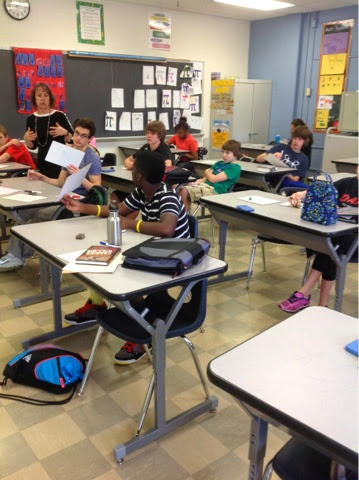
Ms. Frank shared these photos from yesterday's classroom. In this lesson, her student teacher, Miss Scott, engaged students in parallel lines with a transversal by having students develop their own replica.  Students used their design and then worked collaboratively to formulate answers to questions about the content.


Inspiration #2
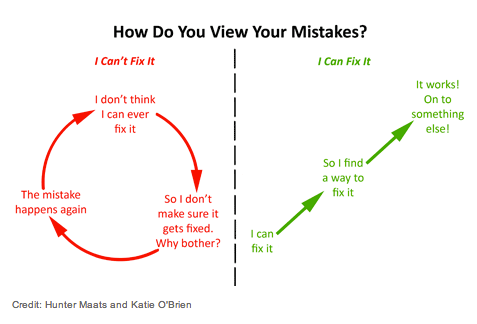
Jackie Gerstein, Ed.D., posted this photo on Twitter not long again, and it really made me think about the learning process.  This is a great photo to share with students to expand their growth mindset...we can all grow and learn if we think we have the power to do so!

Inspiration #3
I don't think I've said it enough this year, so here goes, "I love stations!"  There, I've said it.  And, to further my point, here's a great article from Edutopia (I highly recommend you follow them on Facebook, Twitter, etc.) that merges Flipped Classroom models with stations.  For those of you who've wanted to try "Flipping," this article addresses real concerns about the model and provides realistic solutions.  Check it out:  http://www.edutopia.org/blog/flipped-classroom-in-class-version-jennifer-gonzalez?utm_source=twitter&utm_medium=post&utm_campaign=blog-flipped-classroom-in-class-version-image.

Inspiration #4
And, last but not least for this week's blog, an opportunity to reflect about grading.  This is a conversation that we will be having in much more depth in the coming months, but in the meantime, I recommend Justin Tarte's blog to get you thinking:  http://www.justintarte.com/2014/04/10-questions-to-start-grading.html.


Wednesday, April 16, 2014

Y=MX+B (to the tune of YMCA)

Who knew you could get kids to remember formulas with some bad 70s music?  Apparently, the math department did because they are getting kids "MAP-ready" with their study of intercepts.

You all know how I feel about "MAP Prep," but if you can't remember, let me remind you:  if we have relevant and rigorous instruction (+ a little fun) all year, we are prepared.  There is no specific need to review for state testing.

So, in the spirit of "MAP Prep" is bad, I'd like to point out some good old instruction that while supporting upcoming testing also reflects best practices in instruction:

1)  Group Work:  Getting kids to dialogue about their learning is an excellent way for them to retain understanding.  In the pictures below, notice how engaged students are in the "Book Clubs."


2)  Students developing questions, forming hypotheses to answer their questions, investigating those questions, and summarizing the results:  Below, you will see a student "dressed for success" sharing his findings with the class.  To expand beyond presentation style, students ask questions that require a clear expertise on the experiment's process and results.


3)  Formative assessment to keep kids engaged and provide intervention:  Below, you will notice the use of white boards to ensure students are thinking about mathematical problems and determining a solution.  It is noteworthy that eValuate data helped the teacher determine areas of remediation for the class.


4)  Building Vocabulary:  Student comprehension is contingent on their understanding of words.  Whether they build understanding through inferring word meaning or by practicing use of vocabulary, it's an essential element of reading comprehension.  I can't help but wonder, "Do we even use those MAP Words of the Day? Are they effective?  Do we need to revisit those?"


5)  Kids Teaching Kids:  Let's face it, we are all an expert in something and when we get to demonstrate our expertise, we cement what we already knew, enhancing that expertise.  Here, kids are reviewing math concepts from eValuate by teaching one another how they did it.


 6)  Determining the Question:  Teaching kids skills to determine what's expected helps them focus and again, build comprehension.  Check out this great example of students circling, underlining and boxing in key words in a question.


7)  Thinking Abstractly about Concrete Learning:  Ask your self, "What kind of triangle would I be and why?"  In this class, students demonstrated their understanding of the types of triangles by justifying how they fit their personality.  All I can say is that I'm an equilateral triangle - can anyone guess why?  (Not you, Ms. Frank and Miss Scott).