Tuesday, August 27, 2013

We Have Class at TMS!

We have math class; we have English class; we have art class; we have FACS class; ....and...we have Flyertime class.  Thinking about Flyertime as a class really helps to give it focus and purpose.  Consider these techniques to improve the identity of Flyertime as a class...

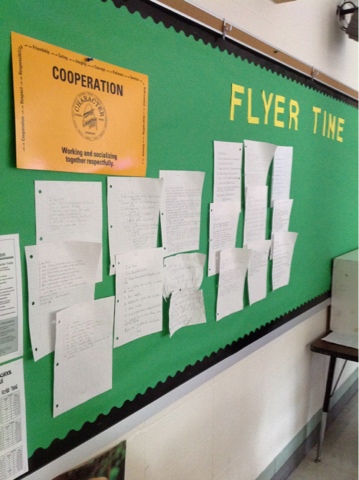
Give it its own space - a bulletin board where student work is displayed is one way you can highlight the "Class."

Identify it's objective - just like any class, we have objectives for what we want students to learn in Flyertime.  Highlight that so that students have a better sense of purpose for the class as well.

Forming a Collaborative Partnership!

CT is a powerful resource.  Whether you get to collaboratively teach with a special education, general education or student teacher, this is an opportunity to reach more kids with more effective instruction.  So consider how you set up your collaborative teaching partnership...

Do you introduce your partner in first day activities, on Open House?
Do you both lead whole group instruction?
Do you divide the class into smaller groups to share instructional leadership?
Do you take turns providing assistance to students?

As the year progresses, we will be focusing on this collaborative journey, so start considering now what you can do to improve your partnerships.

Thursday, August 22, 2013

Learning is Messy Business

Look at this mess!                                                BUT.....here's learning in action!
      

Students in 7th grade math had a task:  build a tall tower.  That was it.  No other directions.  No other facilitation.  Given a short period of time, students had to analyze, discuss and solve the problem.  And, the result was a better understanding of problem-solving and integrated science concepts.

Each PLC member chose their own way to teach the concept; in the below classroom, stations (You know I love those!)were used to incorporate this activity as well as nitty gritty, must do details in an engaging and sytematic way.

 
Station:  Building the tower          Station:  Getting their data tracking sheets ready

  
Station:  Getting their math books              Station:  Practicing white board use and math problems

Station:  Practicing using math measurement tools

Wednesday, August 21, 2013

Taking Care of Business Everyday...Everyway!

How do you set up routines and procedures in your classroom?  Do students know what their learning expectations are? Do students understand how to treat technology in your room? Take a look at these great pics which emphasize clear classroom expectations.

Here, students understand their learning objective, the agenda and their homework expectations - no questions need be asked!


In this example, technology displays the learning objectives, agenda, and homework.  Technology can be used in this way either throughout the class or as an overview at the beginning of the class where students are reminded to write their homework in their agenda (or other tool).

.  photo.JPGLook at this beautiful display of technology:  students know to put their computers back with cords plugged in and safely tucked away to ensure no "oops" result in broken technology.

Monday, August 19, 2013

Rollin Out the Google Apps

Let's build student leadership and knowledge with Google Apps! Check out how 8th grade engaged students in the use of new technology and gave them a sense of purpose while initiating them to Google Apps and the expectations of their use.

It all started with a challenge - students work independently to master each task.


It continued with those students who were most comfortable with the various Google applications offering to be "experts" to help their peers better understand the skills. 


It's important that we all know what kids are learning so we have consistent expectations school-wide.

Thursday, August 15, 2013

What tone did you set?

We often take for granted the importance of first impressions.  But today, we've made great first impressions with our students.  Not only have we taken care of the "nitty gritty" details that kids need to know, but we've also shown them that we value them as members of the class.  

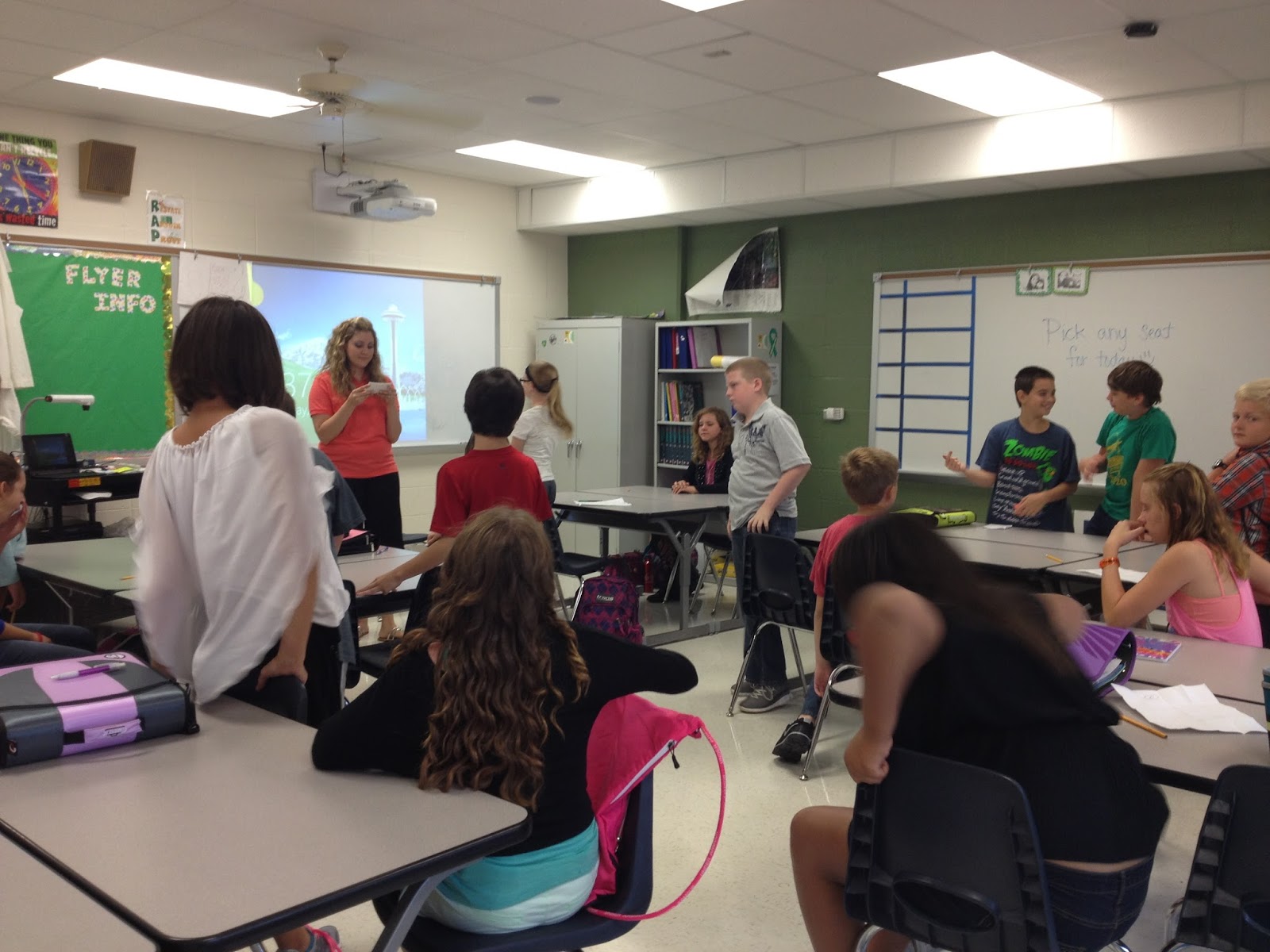
By actively engaging students, we tell them that their participation is important and necessary for success.  Check out these great examples of introductory lessons!

You know I love a good station!  In this class, students are getting acclimated to the learning that will occur throughout the year by demonstrating prior knowledge and practicing essential skills for success

How about a little kinesthetic activity to get to know your students and build classroom climate?  In this class, students listen to descriptors and remain standing if the descriptor fits them.  Students and the teacher know a lot about the last one standing.  

And, a little BYOD.  In this class, students find the QR codes hidden around the room.  Each code takes them to a question about themselves and their learning.  This is a great way to get kids to use their devices to provide feedback about themselves.

Monday, July 29, 2013

What Was I Thinking When I Wore White Pants Today?

I'm messy, I spill things constantly, so what was I thinking?  By 9 a.m., the splatters of my Diet Dr. Pepper clearly indicated that I took a bad risk.  But so what?  What's the worst that will happen? Okay, I have to explain my stains to CO when I go there for my meeting this afternoon, but I'm pretty sure that the stains are treatable and my white pants will be saved to be stained another day...

And now, you're wondering, "What in the world does this have to do with instruction at TMS?"  Well, a lot actually because what's the worst that can happen when you take an instructional risk?  The kids won't get it?  You'll have to teach the lesson another way?  You'll have lost a little instructional time?

But...

What about the benefits to that risk?  I mean, I love these white pants and the whole look of my outfit, so I think the benefit of being "cute" outweighs the risk of spillage.

The potential benefits of trying something new with teaching and learning are rewarded when kids transfer knowledge because of deeper and more authentic learning.  Consider these risk-taking moves from the 2012-13 school year:

Online book clubs in Edmodo
Blowing up nitrogen in the science lab (not sure I recommend this for everyone)
Flipped classrooms
Creating bills to become TMS "laws"
One-note usage
Student collaborations with Padlet
Making books for children without access to literature
Letting control of classroom instruction to allow more student autonomy
Use of CT strategies
Station Teaching
Screencastomatic to support student learning
And so much more that I can't think of right now....

This year, I plan to take more risks in my own use of technology, working to model strategies that can be easily transferred to the classroom.  Mike plans to ride Bus 2 (and trust me, that's a risk!)

Now, what instructional risk will you take in 2013-14???????