I confess that this summer I've been breaking the rules....wait for it....
I've been entering the TMS parking lot the wrong way! What? For Shame! It's true. So, now I'm feeling rebellious and want to challenge you to break some "rules." Don't get me wrong, I'm not advocating for you to do anything that will result in orange as the new black, but what can you do differently this year?
Break your mindset: Learning isn't about being the first to the finish line; it's a journey of ups and downs that ends with gained knowledge and skills that weren't previously present. Break the rules by helping kids appreciate the learning struggle; this helps students learn resilience and perseverance.
Break the tradition of efforts and achievement being the same thing: Learning and effort are not synonymous. Some kids put in a lot of effort, but in the end, they still struggle with mastering the content. Other kids pick up the content right away and find the need to "show" effort through ongoing assignments a waste of time. Break the pattern by focusing your classroom grades on learning; let effort be scored using the effort scale only.
Break away from one size fits all: Many kids get to the "finish line" first because they already learned the content. How do you enrich their experience and develop their passion for deeper learning of that content? Break through this slump by pre-assessing students and developing tiered assignments to engage all kids.
Break down the walls: Learning doesn't just happen in the school environment. Rich learning happens in authentic settings where kids have a clear purpose and relevance for learning. Break out into the community for learning opportunities so that kids can be motivated to develop their skills and knowledge.
These are just a few ideas about how you can break the rules -- you know that I'm always open for additional thoughts, so share some ways you've "broken rules" in your classroom structure in the comments section below!
Wednesday, July 9, 2014

Monday, July 7, 2014
An Epiphany
How often do we involve parents in their children's learning? Let's be honest, is it once a year at Student-Led Conferences? Do we include Open House and Curriculum Nights and say that it's three times per year? Now, ask yourself this --- is it enough?
I don't think so...
In Educational Leadership's article "Parents as Writing Partners," they offer great suggestions for engaging parents in the writing process.
Consider how many of our parents would take a more active role if they had questions suggested to them, questions such as...
But, this shouldn't be limited to writing. Consider the implications for all content areas: the rich dinnertime conversations that could be had about science, technology, arts, and history.
Part of our back-to-school PD will be focused on engaging parents in student learning. To help you prepare, begin thinking of dinnertime conversation starters that you can send home at the beginning of units, or on a quarterly basis.
We have so much to gain by expanding the classroom into the home!
I don't think so...
In Educational Leadership's article "Parents as Writing Partners," they offer great suggestions for engaging parents in the writing process.
Consider how many of our parents would take a more active role if they had questions suggested to them, questions such as...
- What do you want your reader to know right away?
- How are you going to tailor this piece to your audience?
- What will be the tricky part -- where it might get confusing? Let me know when you're at that part, and we can talk it out if you want. (Ehrenworth, April 2014, pg. 24)
But, this shouldn't be limited to writing. Consider the implications for all content areas: the rich dinnertime conversations that could be had about science, technology, arts, and history.
Part of our back-to-school PD will be focused on engaging parents in student learning. To help you prepare, begin thinking of dinnertime conversation starters that you can send home at the beginning of units, or on a quarterly basis.
We have so much to gain by expanding the classroom into the home!
Friday, May 23, 2014
We're always thinkin'
It may be May, but we are still thinking, and learning, and thinking, and learning...
 |
| Designing and Creating Structures |
 |
| Beating his time solving the Rubik's Cube |
 |
| Charting Data |
 |
| Building Rockets |
 |
Getting ready to launch and the launch below |
 |
| A successful launch |
 |
| Taking a Final (Yes, I Said Final) |
 |
| Geometric Wallpaper |
 |
| Finding Examples of Simple Machines Around the Building |
 |
| Reading background information |
 |
| Discussing historical events and bias |
Thursday, May 22, 2014
Not Your Momma's Interview
Interviews are changing. Gone are the days where we meet you for 30 minutes, ask you some questions, and then bam, you're selected. This year, we've seen most of our candidates teach. Whether it's a Fellow we've hired (because, let's face it, isn't the Fellows program a yearlong interview? - assuming there's an opening, of course).
In the pictures below, a prospective PE candidate taught an integrated health/fitness lesson to our 6th grades. Spoiler Alert - we hired her!
In the pictures below, a prospective PE candidate taught an integrated health/fitness lesson to our 6th grades. Spoiler Alert - we hired her!
 |
| Students rotated through stations for their warm-up. Stations were highlighted by color-coded cones and technology that timed and transitioned students between activities. |
 |
| A quick mini-lesson on "My Plate" to lead into the main event of the lesson. |
 |
| Students worked in groups to "create" their plate. Each item taken from the center had a physical activity to complete. |
 |
| After gathering all their foods, students designed the healthiest option based on "My Plate's" portions. |
 |
| A little yoga to mentally and physically end the class. |
Wednesday, May 7, 2014
No Trash Talk
When science teachers ask you to save your "garbage," don't you wonder what they're going to do? After all, why do they need all of those 2-liter bottles, jars, paper and other random products?
To create, of course...
See the pictures below as the race was on in one science classroom: with the time and materials given (paper and 1 meter of tape only), students were to create the tallest tower they could. And, there was no trash talk allowed!
And then, we have the 7th grade parachutes, and more random materials...
The culmination of all these crazy materials and experiments is getting kids to think critically. Because we do such a great job of this, all 14 of our St. Louis Science Fair participants earned a ribbon, and one even earned a $200 prize from Monsanto. Great job!

To create, of course...
See the pictures below as the race was on in one science classroom: with the time and materials given (paper and 1 meter of tape only), students were to create the tallest tower they could. And, there was no trash talk allowed!
 |
| Prepping the classroom is messy work |
 |
| The competition begins |
 |
| Survival of the fittest |
 |
| Building the tower |
 |
| Another tower in process |
 |
| And, of course, clean up |
 |
| Getting ready to drop |
 |
| Measuring the speed |
Monday, May 5, 2014
MAP's Over! So What?
Yes, the "big test" is over, but rigorous and relevant learning is not. Check out what goes on at TMS after the MAP!
 |
| Teachers model investigations of gravity and speed. |
 |
| Math practice happens with modeling and student feedback. Notice the use of those white boards! |
 |
| Students create their own videos to demonstrate understanding of weather. I have to admit, it was clever! |
 |
| And, here's another, complete with an original song and dance! |
 |
| Student Research and Product Development |
 |
| Annotating Text |
 |
| Annotating Text and Vocabulary Development |
 |
| Visual Representations of Learning |
 |
| Collaborative Work |
Thursday, April 24, 2014
Citing My Sources
This post is not comprised of my original work; instead, what you see here are 4 inspiring examples that have been shared with me or that I've discovered in my own research.
Inspiration #1
Ms. Frank shared these photos from yesterday's classroom. In this lesson, her student teacher, Miss Scott, engaged students in parallel lines with a transversal by having students develop their own replica. Students used their design and then worked collaboratively to formulate answers to questions about the content.


Inspiration #2
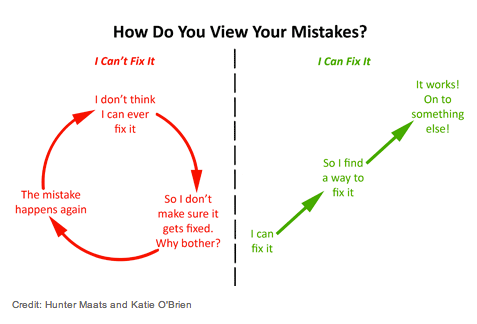
Jackie Gerstein, Ed.D., posted this photo on Twitter not long again, and it really made me think about the learning process. This is a great photo to share with students to expand their growth mindset...we can all grow and learn if we think we have the power to do so!
Inspiration #3
I don't think I've said it enough this year, so here goes, "I love stations!" There, I've said it. And, to further my point, here's a great article from Edutopia (I highly recommend you follow them on Facebook, Twitter, etc.) that merges Flipped Classroom models with stations. For those of you who've wanted to try "Flipping," this article addresses real concerns about the model and provides realistic solutions. Check it out: http://www.edutopia.org/blog/flipped-classroom-in-class-version-jennifer-gonzalez?utm_source=twitter&utm_medium=post&utm_campaign=blog-flipped-classroom-in-class-version-image.
Inspiration #4
And, last but not least for this week's blog, an opportunity to reflect about grading. This is a conversation that we will be having in much more depth in the coming months, but in the meantime, I recommend Justin Tarte's blog to get you thinking: http://www.justintarte.com/2014/04/10-questions-to-start-grading.html.
Inspiration #1
Ms. Frank shared these photos from yesterday's classroom. In this lesson, her student teacher, Miss Scott, engaged students in parallel lines with a transversal by having students develop their own replica. Students used their design and then worked collaboratively to formulate answers to questions about the content.
Inspiration #2
Jackie Gerstein, Ed.D., posted this photo on Twitter not long again, and it really made me think about the learning process. This is a great photo to share with students to expand their growth mindset...we can all grow and learn if we think we have the power to do so!
Inspiration #3
I don't think I've said it enough this year, so here goes, "I love stations!" There, I've said it. And, to further my point, here's a great article from Edutopia (I highly recommend you follow them on Facebook, Twitter, etc.) that merges Flipped Classroom models with stations. For those of you who've wanted to try "Flipping," this article addresses real concerns about the model and provides realistic solutions. Check it out: http://www.edutopia.org/blog/flipped-classroom-in-class-version-jennifer-gonzalez?utm_source=twitter&utm_medium=post&utm_campaign=blog-flipped-classroom-in-class-version-image.
Inspiration #4
And, last but not least for this week's blog, an opportunity to reflect about grading. This is a conversation that we will be having in much more depth in the coming months, but in the meantime, I recommend Justin Tarte's blog to get you thinking: http://www.justintarte.com/2014/04/10-questions-to-start-grading.html.
Subscribe to:
Posts (Atom)